How a honeycomb vent works
Each cell of the honeycomb is a waveguide. Above a certain frequency, called the cut-off frequency, a waveguide does not propagate energy — it attenuates it. So a stack of tubes whose diameter is below cut-off for the frequency you care about behaves like a solid wall electromagnetically, while air still flows through it.
The relationship is simple and worth remembering: the smaller the cell and the longer the tube, the lower the cut-off frequency and the higher the attenuation. That is why you cannot judge a vent by its dimensions alone — cell diameter and thickness have to be considered together.
Cut-off wavelength for a circular waveguide is roughly 1.706 times its diameter, so a 3.2 mm cell stops propagating below about 55 GHz in free space. In practice attenuation at the frequencies you care about comes from the tube length, not from being below cut-off — which is why thickness matters more than most buyers expect.
Standard specification
| Property | Range |
|---|---|
| Cell diameter | 2.5 mm, 3.2 mm, 4.0 mm, 5.0 mm, 8.0 mm (other sizes to special order) |
| Thickness | 5 mm to 120 mm |
| Core material | Tin plated steel, stainless steel, aluminium, brass |
| Foil thickness | 0.15 mm typical for tin plated steel core |
| Frame | Steel, stainless steel or aluminium, welded or flanged |
| Finish | Tin, nickel, zinc, or bare stainless |
Measured attenuation: 3.2 mm cell, 25 mm thickness, tin plated steel
| Frequency | 1 kHz | 10 kHz | 100 kHz | 1 MHz | 10 MHz |
|---|---|---|---|---|---|
| Electric field | 20 dB | 70 dB | 90 dB | 100 dB | 100 dB |
| Magnetic field | 100 dB | 100 dB | 100 dB | 100 dB | — |
Measured attenuation: 4.0 mm cell, 25 mm thickness, tin plated steel
| Frequency | 1 kHz | 10 kHz | 100 kHz | 1 MHz | 10 MHz |
|---|---|---|---|---|---|
| Electric field | 29 dB | 72 dB | 108 dB | 115 dB | 115 dB |
| Magnetic field | 105 dB | 110 dB | — | — | — |
The 4 mm core outperforms 3.2 mm at every frequency shown, at almost the same cost and with less airflow restriction. That is not a contradiction — the 4 mm cell is a larger tube with the same length, and attenuation in this band is dominated by the electroplated foil's conductivity and the tube length rather than by cut-off margins. In practice most shielded room buyers who ask for 3.2 mm would be better served by 4.0 mm.
Third-party test report
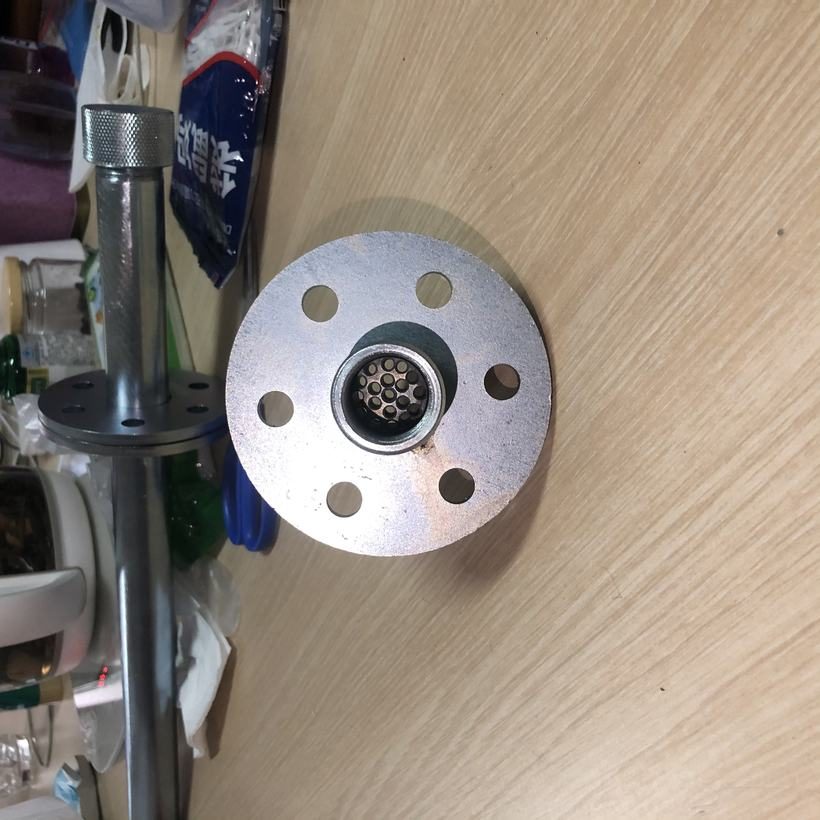
Our shielded room ventilation waveguide was tested by the Xi'an Electronic Engineering Research Institute Calibration Lab (NORINCO Group North General Electronics Group) to GB/T 12190–2006, certificate PBS20130715-2, 15 July 2013. Two samples, horizontal and vertical polarisation, measured at 14 kHz, 300 kHz, 1 GHz, 10 GHz and 18 GHz:
| Polarisation | 14 kHz | 300 kHz | 1 GHz | 10 GHz | 18 GHz |
|---|---|---|---|---|---|
| Horizontal | ≥110 dB | ≥124 dB | ≥145 dB | ≥129 dB | ≥110 dB |
| Vertical | ≥110 dB | ≥124 dB | ≥145 dB | ≥129 dB | ≥110 dB |
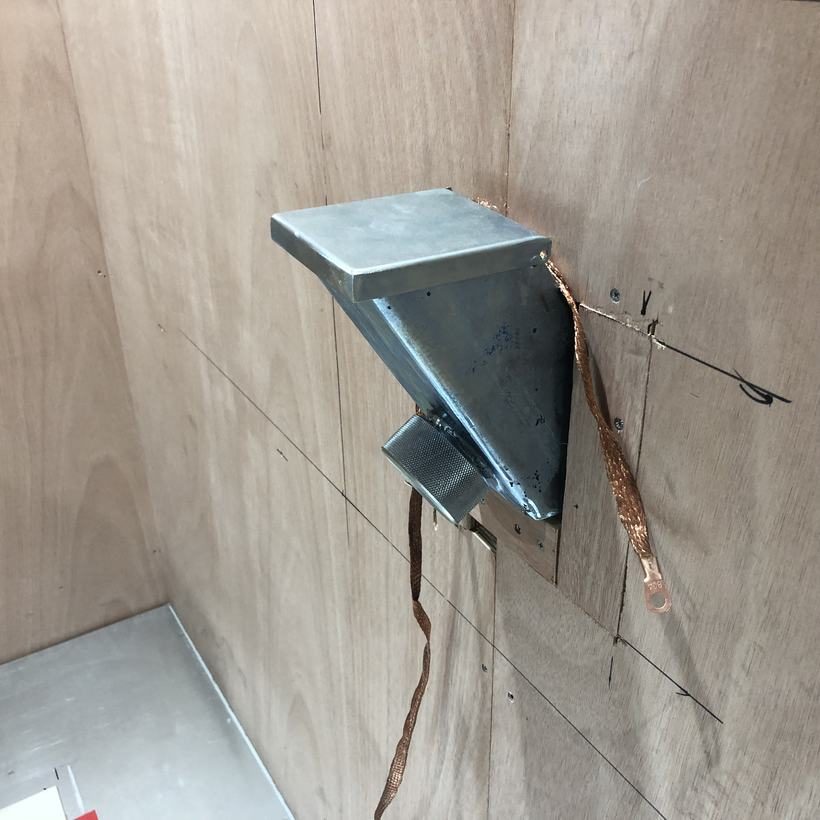
A copy of the report is available on request. Note that shielding effectiveness of a mounted vent in a room is lower than the free-standing value — the frame bond and the surrounding panel are part of the measurement, and a vent that tests at 145 dB on the bench can measure 90 dB in a badly bonded installation.
Fibre optic wave tubes
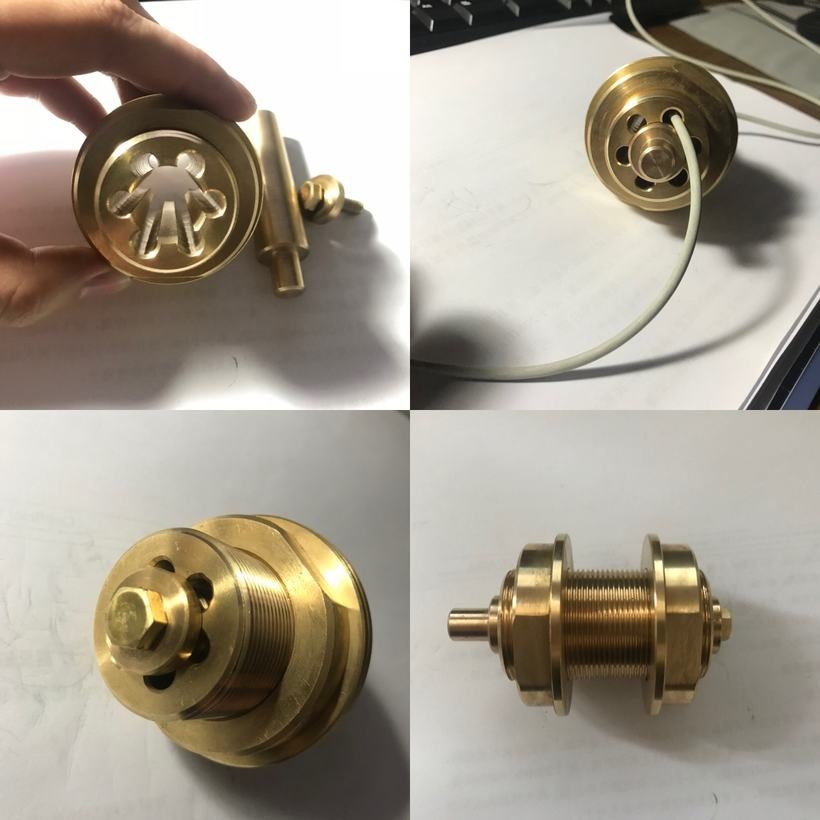
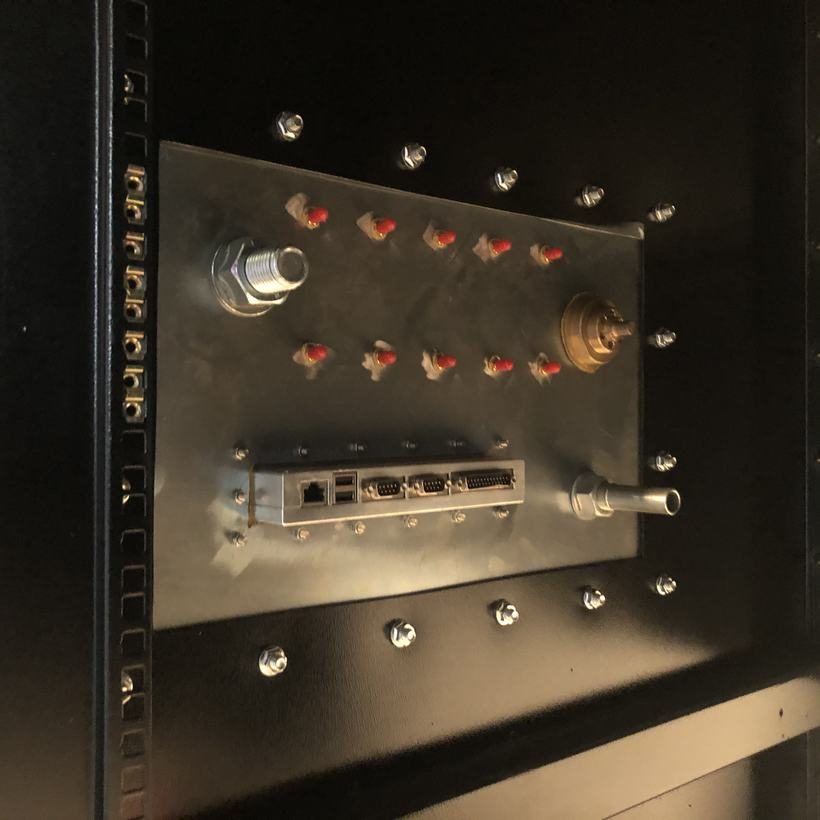
Fibre should not enter a shielded room through a vent. The optical cable itself is non-conductive, but the connector, the jacket and the way it is fixed will leak if the penetration is not properly designed. We make a dedicated fibre wave tube assembly for this.
HM-WT-8R-4: eight 4 mm brass tubes in one assembly, with a removable tapered cylinder in the middle position for connectors up to 14 mm diameter. Cable up to 4 mm stays in the 4 mm tubes; larger connectors pass through the centre, then the taper is reassembled and fixed with the end screw.
The measured isolation of this assembly, tested 25 June 2022:
| Frequency | 600 MHz | 1.7 GHz | 3.5 GHz | 6 GHz | 10 GHz | 18 GHz | 26 GHz | 30 GHz | 35 GHz | 40 GHz |
|---|---|---|---|---|---|---|---|---|---|---|
| Isolation | 102 dB | 125 dB | 128 dB | 114 dB | 101 dB | 113 dB | 93 dB | 96 dB | 86 dB | 86 dB |
Performance is best between 1 and 10 GHz and degrades above 26 GHz, where the tube is no longer long enough relative to the wavelength. If your application runs to 40 GHz and needs more than 90 dB there, the tube has to be longer — which is a design change, not a catalogue option.
Frequently asked
Which cell size should I choose?
Smaller cells give more attenuation, especially at high frequency, but restrict airflow and cost more. For most shielded rooms 3.2 mm and 4.0 mm at 25 mm thickness cover the requirement. Use 2.5 mm only when the frequency range demands it, and 8 mm only where airflow matters more than attenuation.
How much airflow does a vent cost me?
Roughly proportional to open area, which is high for honeycomb — typically over 90 percent free area. The bigger restriction is usually the frame and the room's filter arrangement, not the core.
Do you make stainless steel vents?
Yes, stainless steel core and frame, for corrosive environments, cleanrooms and applications where plated steel is not acceptable.
What about the frame?
Vents are supplied with or without frames. Frames can be welded, flanged, or drilled to match your panel opening. Send the opening dimensions and the panel thickness.
Can you supply custom sizes?
Yes — almost every vent we ship is made to the room's opening rather than to a catalogue size. Non-standard cell diameters are also available on special order.
Ask about honeycomb vents
Five fields, no registration. We reply to every enquiry within one working day.
Prefer to write or call directly?
sales.cn@hmemc.com | kubohua@hmemc.com | +86 519 8665 1804
Changzhou, Jiangsu, China · Mon–Sat, GMT+8