The door is the weakest point of any shielded room
Panels are welded or bolted and rarely fail. The door opens, closes, gets slammed, has a pallet trolley run into it, and its seal compresses and relaxes thousands of times. When a shielded room fails its shielding effectiveness test, the door is the first place to look.
Three things in a door design decide whether it will still pass in five years:
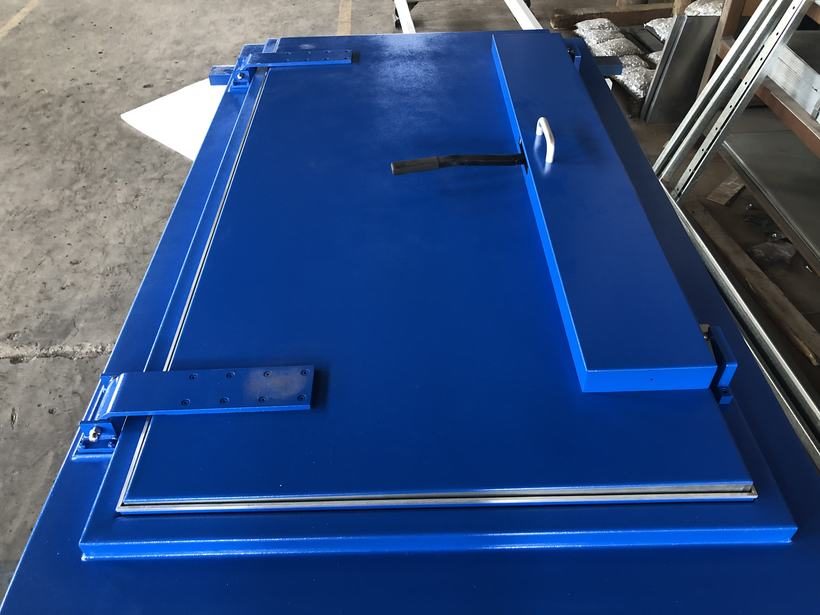
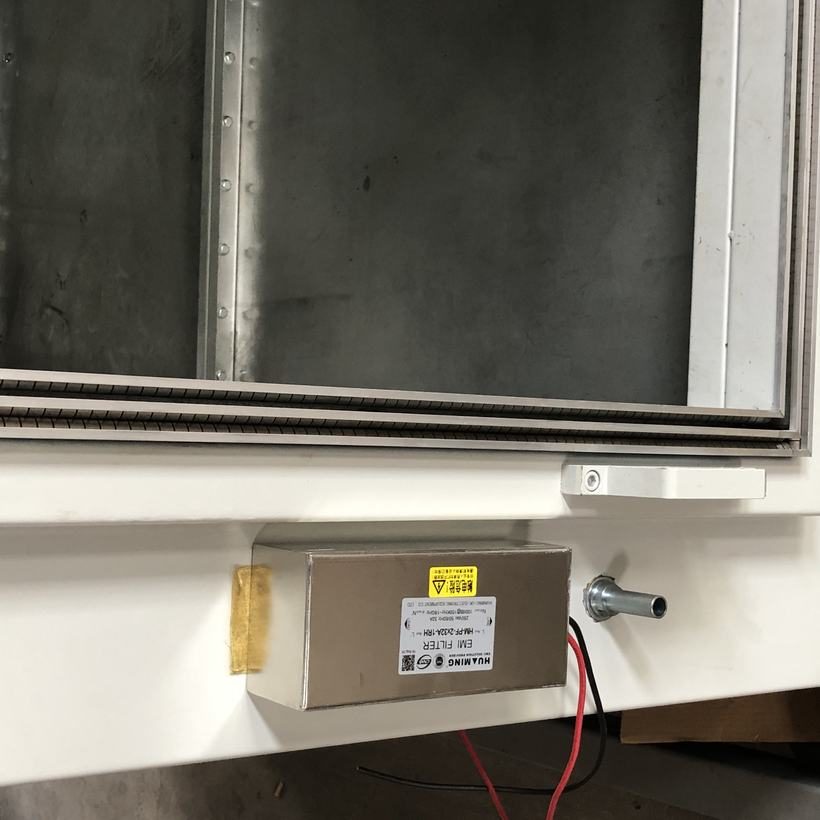
- The seal. A knife-edge (finger stock) seal relies on beryllium copper fingers making continuous contact with a brass or copper blade. A pneumatic seal inflates a conductive gasket against the frame with air pressure, giving far more tolerance of a warped leaf and a much easier closing force for large doors.
- The leaf stiffness. A 3 or 5 metre door leaf that flexes under its own weight pulls away from the seal at the corners. The frame is designed for the leaf, not the other way around.
- How it is operated. A person has to close it, or a motor has to. Both must produce the same result every time, or the seal is only good on the days the operator is careful.
Door types
| Type | Description | Typical use |
|---|---|---|
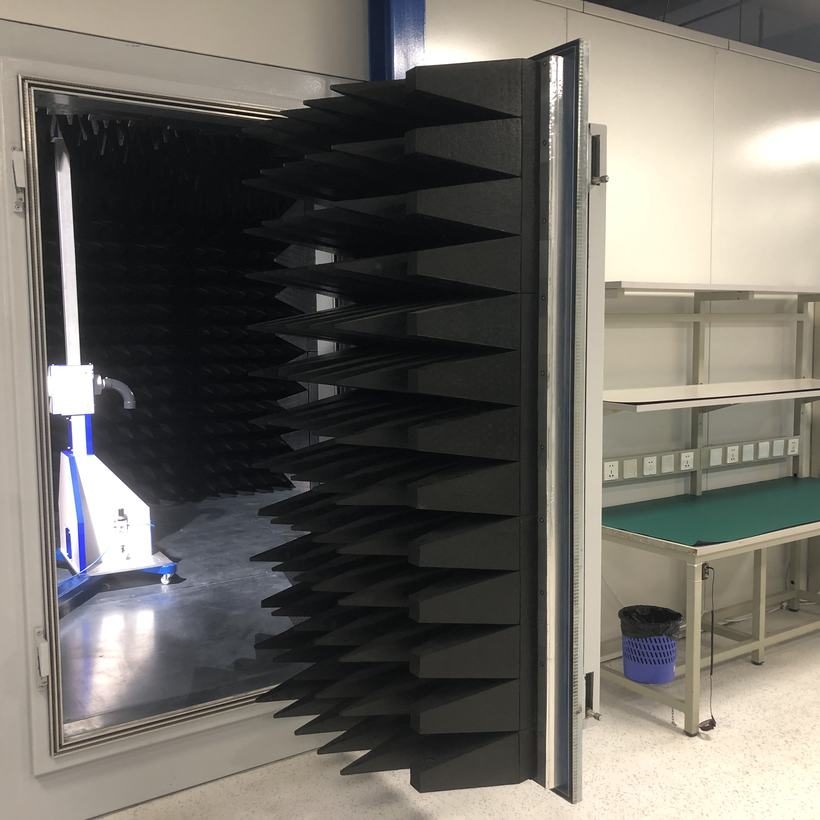
| Manual swing | Hinged leaf, single or double, knife-edge RF seal, lever or wheel handle with cam closing | Small and medium rooms, rooms where traffic is occasional |
| Manual sliding | Floor or top-hung leaf running on rails, manual push with seal engaged by a final cam action | Where a swing door would take up working space |
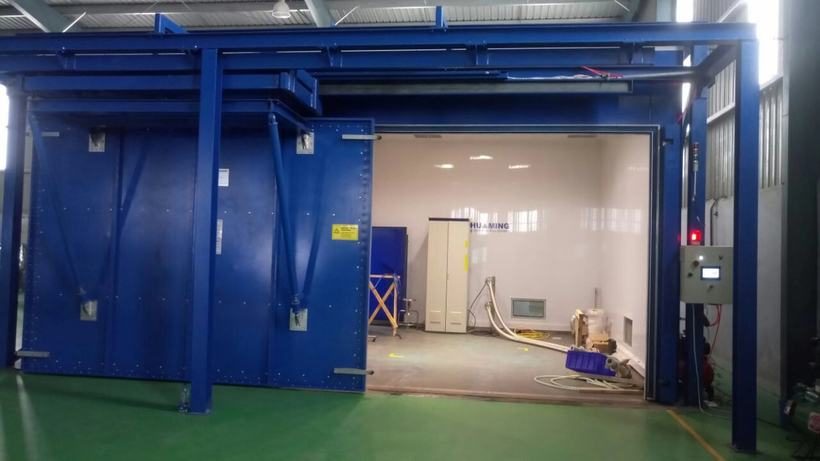
| Motorised sliding | Electric drive with position control, safety edge and interlock, push-button or card access | High-traffic chambers, vehicle access, test facilities in daily use |
| Pneumatic sliding | Air cylinder drives the leaf and inflates the seal against the frame; low closing force, high tolerance of leaf distortion | Large openings, 3 to 5 m, where a mechanical seal cannot hold |
| Double leaf | Two leaves meeting at a centre seal, each with its own seal line | Vehicle and large equipment access |
Specification range
| Parameter | Range |
|---|---|
| Clear opening | Standard 0.9 × 2.0 m up to 5 × 5 m |
| Leaf construction | Galvanised steel frame, copper or galvanised shielding layer, plywood or steel facing |
| Seal | Beryllium copper finger stock (knife edge) or pneumatic inflatable conductive gasket |
| Shielding effectiveness | 100 dB class, frequency range depending on seal type and installation |
| Drive | Manual, electric motorised, or pneumatic |
| Controls | Push button, key switch, card access, interlock with chamber power or RF source |
| Safety | Safety edge, obstruction detection, emergency release on motorised doors |
Where these doors go
Contracted for shielded rooms and anechoic chambers in automotive, aerospace, defence, medical and semiconductor facilities. Notable deliveries include:
- Fourteen shielded doors with matching waveguide vents to the United Arab Emirates
- Twelve-leaf door batches for research facilities in Nanjing, Harbin and Beijing
- Double leaf doors for MRI rooms in Turkey and for RF enclosures in the United States
- Doors for cabin and shelter applications in the UK and Iran
- Motorised sliding doors for a shielded enclosure at a Suzhou facility
Shielding effectiveness of a delivered door has been verified by third-party test in Chinese accredited laboratories for domestic projects; test documentation is available for projects that require it.
Frequently asked
What size can you build?
Up to 5 x 5 metres. Above about 2.5 m we normally specify a pneumatic seal and a heavier leaf and frame; a mechanical seal at that size is possible but the closing force and the long-term gap risk become significant.
Manual or motorised?
Depends on traffic and leaf weight. A door under about 400 kg opened a few times a day is fine manual. Above that, or where the door is used continuously, motorised pays for itself in seal life — a slammed door is an expensive door.
Can the door interlock with my chamber?
Yes. Interlock with the RF source, the power supply or the chamber monitoring system is a normal option, as are safety edges and obstruction detection.
Do you supply the frame with the door?
Yes, and we prefer to. The door and frame are a matched pair; a door supplied into someone else's frame is where sealing performance goes wrong.
Can you replace a door in an existing room?
Usually. We need the existing opening dimensions, the panel construction and the panel thickness. Retrofits are common when an old finger stock seal has worn out.
Ask about RF shielded doors
Five fields, no registration. We reply to every enquiry within one working day.
Prefer to write or call directly?
sales.cn@hmemc.com | kubohua@hmemc.com | +86 519 8665 1804
Changzhou, Jiangsu, China · Mon–Sat, GMT+8