RF shielded cabinets and enclosures: making the box is the easy part
A shielded cabinet is a metal box with a door and a few holes in it. Anyone with a press brake can bend one. What separates a cabinet that holds 100 dB for fifteen years from one that drops to 70 dB after two, is almost never the sheet metal. It is the door, the seams, and what you pushed through the wall.
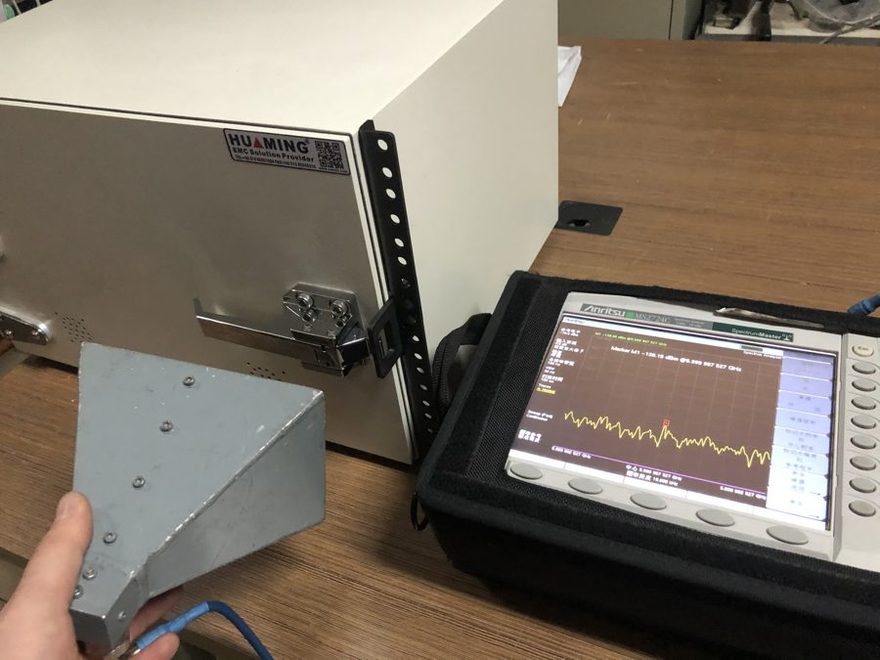
What we actually build
We make three families, and the difference between them is how the magnetic field requirement is met. Below about 150 kHz, a single layer of steel is not enough no matter how well you seal it, because low frequency magnetic fields do not care about conductivity. They care about how much iron is in the way.
| Type | Construction | Typical use | Low frequency performance |
|---|---|---|---|
| Single layer, welded | 1.5 to 2.0 mm galvanised or tinned steel, continuous weld | EMI testing of small devices, shielding of RF sources above 1 MHz | Electric field fine, magnetic field limited |
| Double layer, welded | Two steel skins with an internal air gap, both continuously welded | Military and secure computing, EMC pre-compliance | Meets GJB magnetic requirements from 14 kHz |
| Double layer, moisture sealed | As above, plus sealed cavities and desiccant management | Humid sites, coastal installations, outdoor shelters | As above, without internal condensation over time |
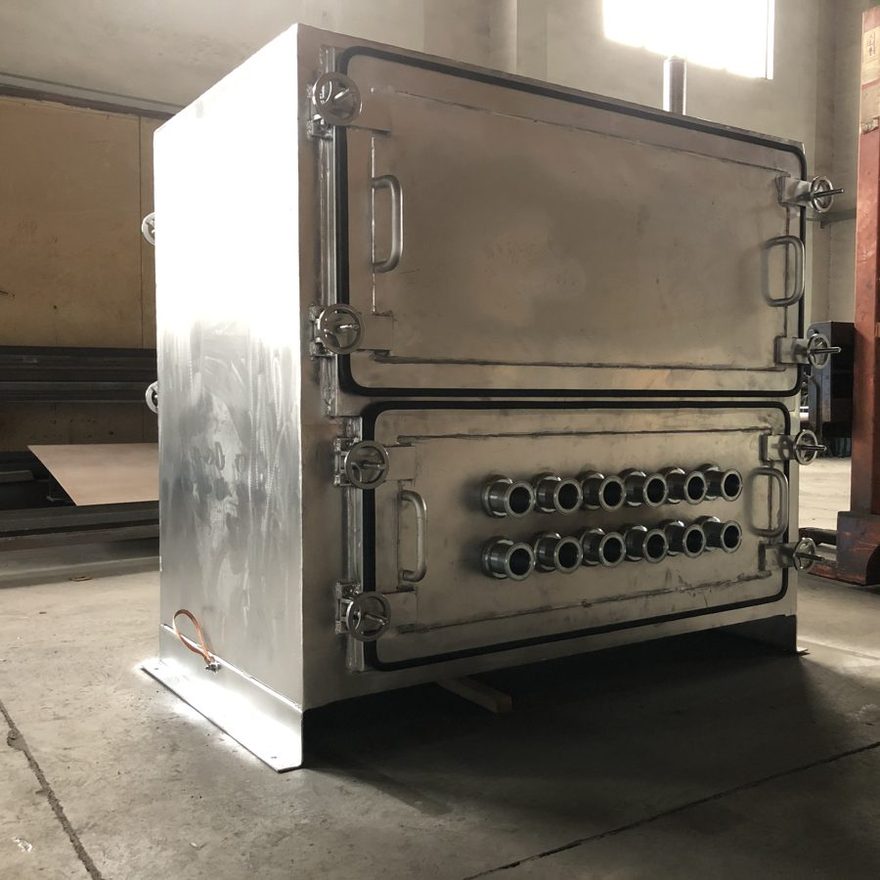
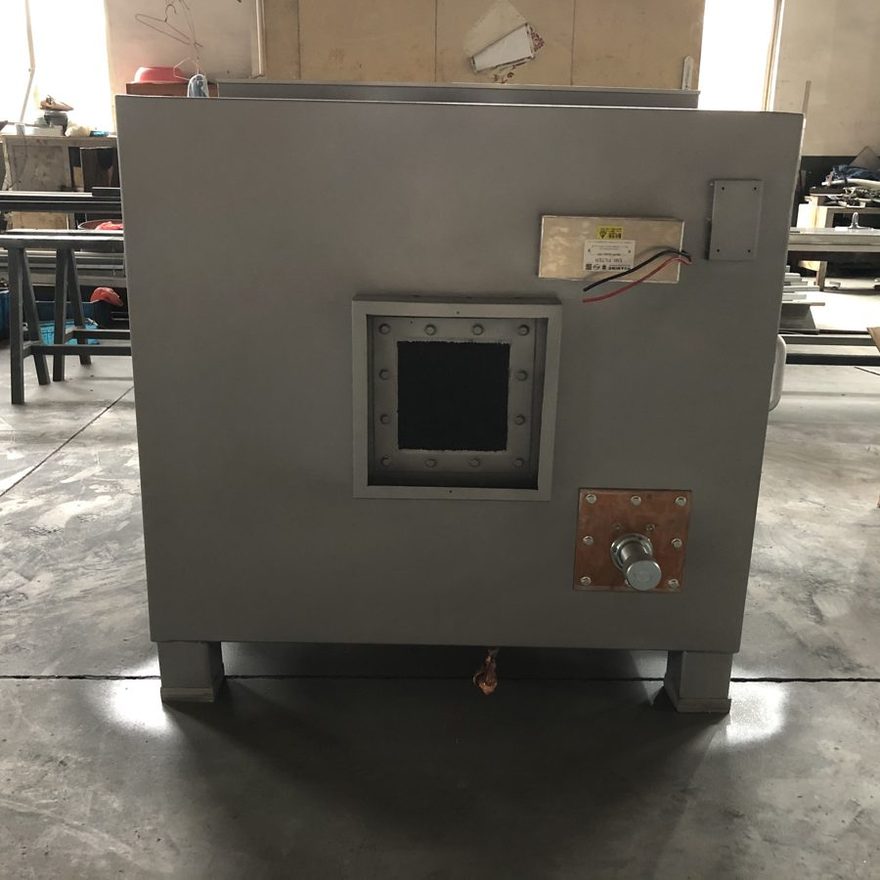
The three joints that decide everything
1. The door seal
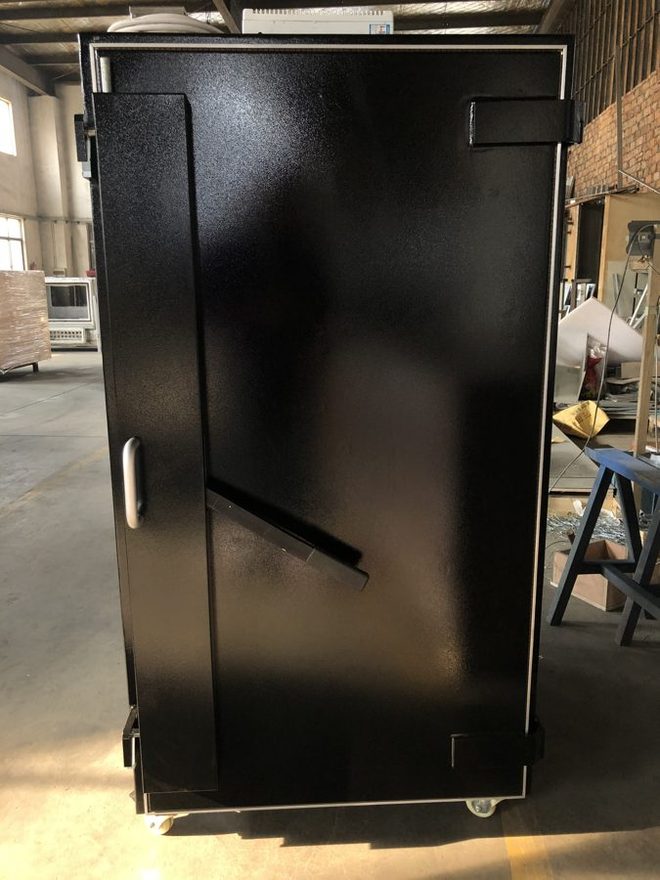
Every shielded cabinet leaks at the door, not through the walls. Beryllium copper finger stock pressing against a machined knife edge is the standard, and it works well, but only if the door has enough stiffness to stay flat and the hinge has enough rigidity that the door does not sag. On a cabinet up to about 1.2 m this is straightforward. Above that, a multi-point latch system is not optional.
The failure mode we see most often in cabinets that arrive for repair is not a worn finger strip. It is a door that no longer sits square, so a two millimetre gap opens at one corner. Every finger there is compressed just enough to look fine and just loose enough to leak.
2. The seam
Continuous weld, not spot weld, not rivet, not conductive gasket between bolted panels. A bolted seam with conductive gasket is fine for a demountable room where someone will re-check the torque. In a cabinet that ships assembled and sits in a corner for a decade, the gasket creeps and the paint film under the bolt heads becomes an insulator. We weld the frame and weld the skins, and we do not use gasket tape anywhere it cannot be re-tightened.
3. What you push through it
This is the one people underestimate. A cabinet with a perfect shell and a power cable led through a drilled hole is not a shielded cabinet. It is a cabinet with an antenna. Every penetration needs to be a designed one: a filter with specified insertion loss, or a waveguide beyond cutoff for a vent, or a screened connector on a properly bonded bulkhead.
Type test results on a delivered cabinet
Not a datasheet claim. This is the measured result on an eight-unit order of moisture-sealed double-wall cabinets delivered to a Chinese military research institute, tested by the Jiangsu Institute of Metrology in July 2025.
Report E2025-40841 to E2025-40848, Jiangsu Institute of Metrology, issued 28 July 2025.
Standard: GJB 5792A-2021, Electromagnetic shielding enclosure classification and measurement methods for military classified information systems.
Sample: double-wall continuously welded moisture-sealed shielded cabinet, type XRDA, serial HM-SC-2507A.
Range tested: 14 kHz to 10 GHz. Result: pass.
The measurement points were the four walls, the door, the power line filter, and three separate power entry points. Shielding effectiveness is reported as the lowest value across all positions, which is the honest way to report it, because a cabinet is only as good as its worst point.
| Frequency | Required | Measured, lowest value | Margin |
|---|---|---|---|
| 14 kHz (magnetic) | ≥ 70 dB | 75 dB | +5 dB |
| 150 kHz (magnetic) | ≥ 95 dB | 98 dB | +3 dB |
| 200 kHz (magnetic) | ≥ 100 dB | 103 dB | +3 dB |
| 15 MHz | not specified | 102 dB | — |
| 50 MHz (electric) | ≥ 100 dB | 105 dB | +5 dB |
| 450 MHz | not specified | 105 dB | — |
| 1 GHz (electric) | ≥ 100 dB | 105 dB | +5 dB |
| 1.5 GHz | not specified | 106 dB | — |
| 3 GHz | not specified | 106 dB | — |
| 6 GHz | not specified | 106 dB | — |
| 10 GHz (electric) | ≥ 100 dB | 104 dB | +4 dB |
Both horizontal and vertical polarisation were measured. The full report runs to six pages per unit and covers all eight cabinets; the figures above are from the first unit, and the other seven sat within a few dB of the same envelope.
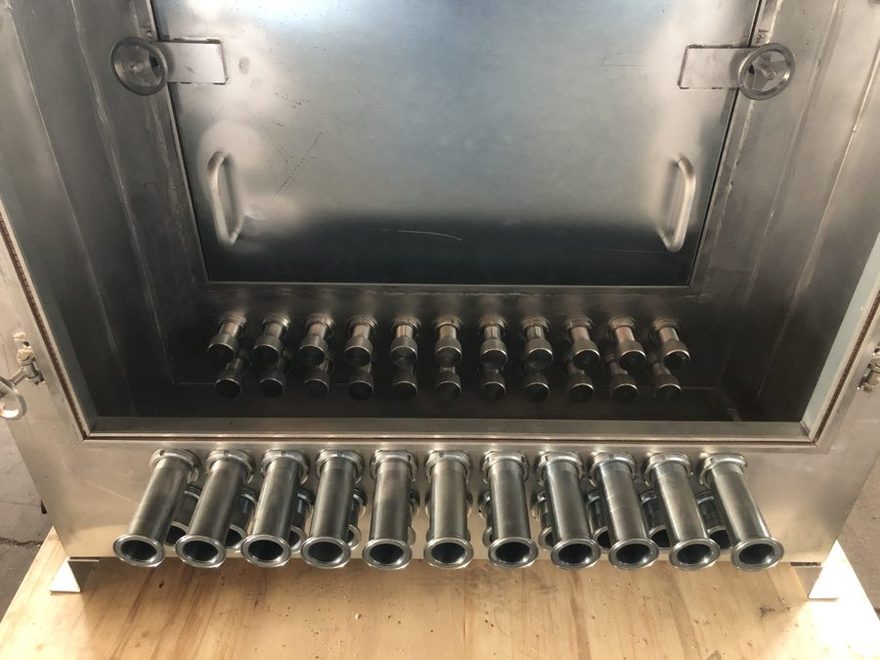
Standard configuration and options
| Item | Our default | Notes |
|---|---|---|
| Shell | 1.5 mm tinned or galvanised steel, double wall, continuous weld | Up to 3.0 mm on request for larger sizes |
| Door seal | Beryllium copper finger stock on machined knife edge | Single or double door, optional observation window with screened mesh |
| Ventilation | Honeycomb waveguide, 3.2 mm or 4.0 mm cell | 4.0 mm cell gives roughly 10 dB more at 100 kHz for about the same cost, and lower airflow resistance |
| Power entry | Single phase or three phase filter, 100 dB common mode, 14 kHz to 40 GHz | DC variants, 400 Hz variants, and military EMP filters available |
| Signal entry | Screened connectors on a bonded bulkhead plate | USB, LAN, RS485, DVI, video, fibre, telephone, fire alarm, audio |
| Interior | Bare galvanised, or powder coat on request | Powder coat must not be applied where it would break bonding paths |
| Accessories | Desiccant tray, interior light, work surface, rack rails | Lighting must be fed through the filter, not through a separate hole |
Sizes
Cabinet sizes follow the equipment, not a catalogue. The most common sizes we build sit between 600 × 600 × 1800 mm for rack-mounted equipment and 2000 × 1500 × 2200 mm for a walk-in enclosure for one or two people. Anything beyond walk-in size becomes a shielded room, and we build those too.
If you are sizing a cabinet for equipment that is still being designed, the useful thing to send us is the equipment envelope plus its cooling load and its cable list. The cooling load determines the vent area. The cable list determines the filter count. Sizing on the equipment drawing alone is how cabinets end up with insufficient vents and retrofitted filters.
Where these have gone
- Chinese military research institutes — eight moisture-sealed double-wall cabinets, type tested as above; further orders for secure computing enclosures under the same standard
- China Academy of Engineering Physics — shielded cabinets and enclosures, type tested to 14 kHz magnetic requirements
- Northwest Institute of Nuclear Technology — eight double-layer electromagnetic shielded cabinets, 2024
- Mianyang, Sichuan — twelve shielded cabinets for a test laboratory, plus lead-lined and moisture-proof variants
- Qualcomm — two shielded cabinets, purchase order 3500033664, 2023
- Broadcom, India — shielded cabinets shipped to the Bangalore SEZ facility, including two 1000 mm cube units
- RAHI, United States — shielded rack cabinets with inspection report supplied at delivery
Questions we get asked
What is the difference between a shielded cabinet and a shielded room?
A cabinet is assembled and tested in our factory, ships as a unit, and needs only a power connection on site. A room is built from panels on site and its performance depends on the assembly quality of whoever builds it. If your equipment fits in something under about 2.5 m in each direction, a cabinet is cheaper, faster, and far more predictable.
Can you supply the type test report with the cabinet?
Yes, for units we test at a third party laboratory. The report belongs to the customer who commissioned it, so if your order is the one being tested, the report is yours. For smaller orders where testing is not commissioned, we supply our in-house measurement record and can arrange third party testing at additional cost.
Do I need a double wall?
Only if your requirement extends below roughly 150 kHz on the magnetic side. Above that, a well-built single wall cabinet will do the job, and paying for a second skin you do not need is money spent on nothing. Ask the question in terms of your lowest frequency of concern, not in terms of what the catalogue calls premium.
How much does a shielded cabinet cost?
It depends almost entirely on the number of penetrations and the filter count, not on the size of the box. A 600 mm cabinet with one filtered power entry and one vent is a much simpler build than a 1500 mm cabinet with four filtered entries, twelve signal lines and a screened window. Send the cable list and we will quote against it rather than against a generic price list.
What is the lead time?
Typically six to ten weeks from approved drawings, depending on the filter types and whether third party testing is included. Filtered entries are usually the long pole, not the sheet metal. If you have a date to hit, tell us the date first and we will tell you what configuration is achievable.
Ask about shielded cabinets
Five fields, no registration. We reply to every enquiry within one working day.